7 active projects. 15-tab Excel spreadsheet. 10-15% margin loss nobody could see.
A construction company managing 7 concurrent projects ran everything from a 15-tab Excel spreadsheet. Cost overruns took 30 days to detect. Work-Smart built Capataz. Result: the CEO sees project costs in real time, early warning system flags margin problems, 10-15% margin gap visible and manageable.

Engineers who built towers but couldn't open a spreadsheet
Concreto is a construction company in the Grupo Portland family, one of the largest construction groups in Argentina. They build residential towers, with 7 active projects running simultaneously and 650 employees, most of them field workers.
When I first spoke with someone close to their operation, the first thing he told me was: "These guys are engineers who don't even know how to open a computer." He wasn't being harsh. He was describing reality. Their cost estimates lived in an Excel spreadsheet with 15 tabs. Their project schedules were perpetually behind and rarely updated. Their certification process, the biweekly documentation cycle where progress is recorded and payments are released, was done manually, with no connection to actual costs.
The CEO would ask a simple question: "How is project 3 doing?" The answer took four days. Not because the information was hidden, but because nobody had it organized. A field engineer had to pull numbers from multiple spreadsheets, reconcile them manually, check against the contract, and then write a response. By the time the CEO got an answer, the situation had already changed.
The real cost of this: Concreto was losing between 10 and 15% of what they should have been earning on every project, purely from operational inefficiency. Late cost detection, material miscalculation, overtime from poor scheduling, and no early warning system when a project started bleeding money. On projects worth millions, that margin loss was significant.
They had tried nothing. Not because they didn't want to, because they didn't know where to start. There was no software, no system, no consultant who had told them: here's what's broken and here's how to fix it. They just kept building the way they'd always built.
Three missing layers. One compound problem.
I spent the first two weeks on-site with their engineers. The data told the story: costs tracked in disconnected spreadsheets, no real-time visibility, and document search that required digging through physical filing cabinets. What I found mapped to three missing layers of the AI Operating System:
Data Layer
Their data wasn't just scattered. It was structurally disconnected. The cost spreadsheet, the certification documents, the contract terms, the schedule, each lived in its own Excel file with no shared structure. The cost items didn't even use consistent formatting. One spreadsheet had 12 tabs just for cost breakdowns. Headers didn't match across files. This meant no system could read their data efficiently until someone restructured it from scratch.
Command Center Layer
The CEO had no real-time visibility into any project. Every data point required someone to manually compile it. The concept of "how is the project going?" had a 4-day answer turnaround. By the time you detected a cost overrun, it had already been bleeding for a month.
Document Intelligence Layer
Their operations generated thousands of pages of contracts, technical specifications, and regulatory documents across multi-year projects. When an engineer needed to check what the contract said about procedures for concrete pouring in specific conditions, they either guessed, called someone, or spent an hour digging through PDFs.
The critical insight from the construction industry expert I consulted: the biggest source of margin loss isn't material costs or labor rates. It's late detection. When you don't catch a deviation until the next certification cycle, every 15 days , you've already burned through overtime, idle equipment rental, and excess labor costs that nobody budgeted for.
Capataz. AI Document System
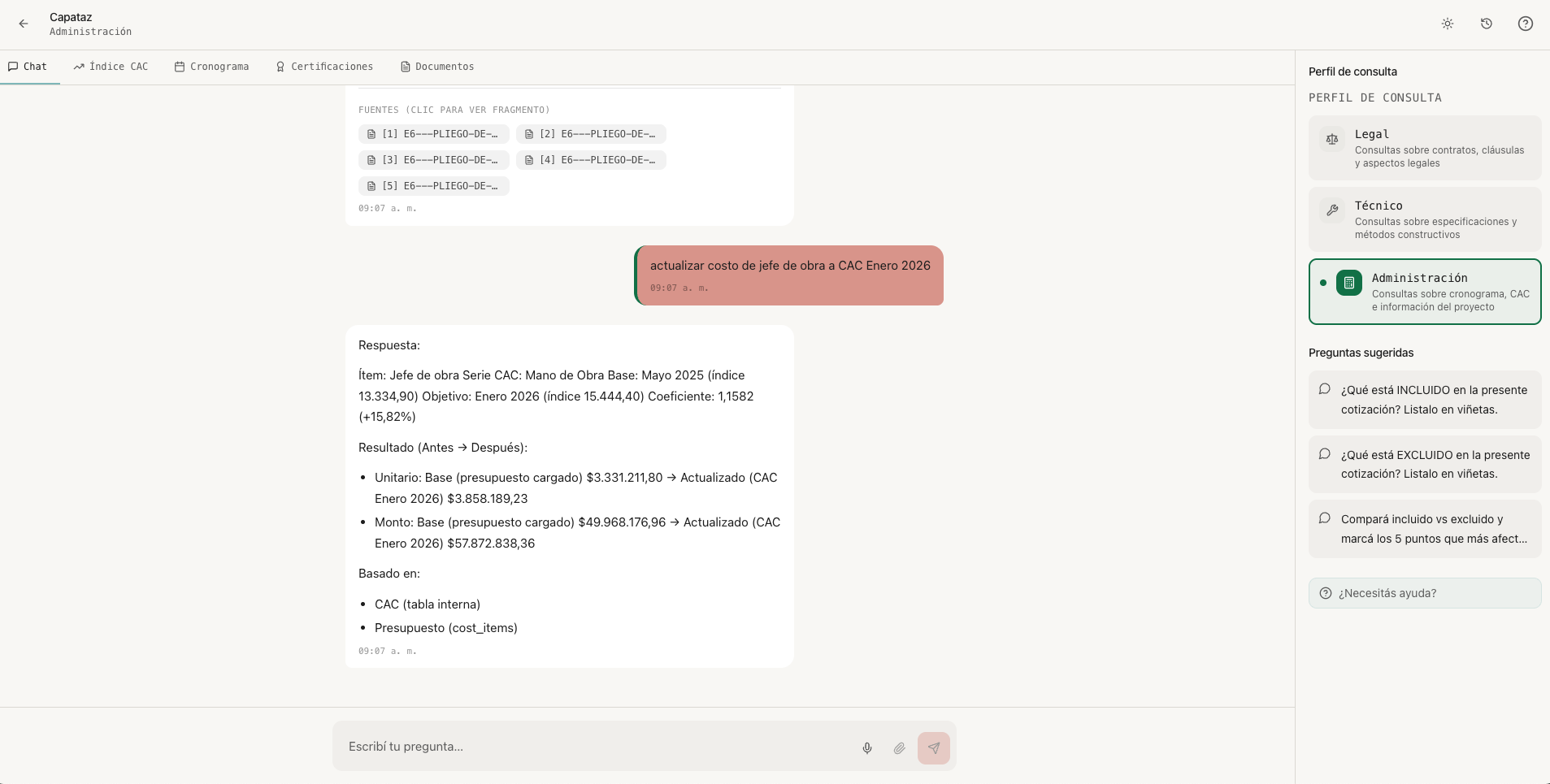
The first thing Concreto needed wasn't a dashboard. It was a way for their engineers to ask questions and get answers without calling someone or digging through filing cabinets. Capataz is an AI system trained exclusively on Concreto's project documents, contracts, technical specs, cost breakdowns, regulatory filings. It doesn't search the internet. It doesn't hallucinate. It answers from their documents and shows exactly where it found the answer. Three profiles serve different roles: legal queries pull from contracts and regulatory documents, technical queries pull from specifications and construction standards, and administrative queries pull from cost sheets and certification records. The system also connects to Argentina's construction cost index (CAC index), automatically updating project costs for inflation every month.
Cost and Certification Engine
The bigger problem was that Concreto's cost data and certification data existed in parallel universes. What they billed (certifications) and what they spent (costs) were never compared in real time. I restructured their entire cost data into a standardized structure: every cost item assigned to a numbered group and category, every certification line linked to its corresponding cost item. Now the system shows total contracted value, amounts updated for inflation, cumulative certified amounts, and, the critical piece, real-time deviation between what was budgeted per phase and what's actually being spent. When a project phase starts running over budget, the alert shows up immediately. Not 30 days later.
Schedule Tracking and Deviation Alerts
Project schedules in construction slip constantly. The question isn't whether the schedule will slip, it's how fast you detect it and what it costs you. I built a phase-by-phase schedule tracker that shows which construction phases are on track, which started late, and where delays are compounding. Each phase links to its cost impact, so a 10-day delay on foundations isn't just a calendar problem, it's visible as the financial exposure it actually is: idle workers, equipment rental running, overhead accumulating.
AI Infrastructure Foundation
With the data structured and the AI working, the next layer is operational: giving field supervisors iPads to report daily progress directly into the system instead of calling the office. Photo capture of receipts and materials that AI extracts into cost categories. Worker management and HR documentation for 650 employees with high rotation. By month 3, field supervisors were using the tablet reporting daily, because it was faster than calling the office. By month 6, they were requesting new features. That's the adoption signal that matters: when the people who resisted the system start asking for more of it.
Project visibility
30-day lag
→Real-time
Document lookup
60 min
→30 sec
Margin loss
10-15%
→Now visible
CEO answer time
4 days
→Seconds
- ▸The CEO no longer finds out about problems after they've already cost money. The system surfaces deviations as they develop, not when someone finally gets around to reconciling a spreadsheet.
- ▸Cost index updates (CAC inflation): was manual lookup and recalculation every month, now automatic. System pulls indices and recalculates.
- ▸Document search across contracts and specifications went from manual dig through PDFs and filing cabinets to AI search with sourced answers.
- ▸Certification preparation went from manual reconciliation across disconnected spreadsheets to structured data with automatic cost-to-certification linking.
- ▸The margin recovery is a path, not a switch. The infrastructure to detect these problems now exists. Closing the gap is ongoing work, and that's what the monthly retainer covers.
Questions About This Case Study
The first version of Capataz (AI document search + cost tracking) shipped in 8 weeks. The full system, including certification engine, schedule tracking, and deviation alerts, was built over 9 months. Construction is complex. The technology is straightforward; the data restructuring and field adoption take time.
This was an AI Foundation Build tier engagement. The build was structured in milestones tied to deliverables: Phase 1 Capataz system, Phase 2 cost and certification engine, Phase 3 schedule tracking, Phase 4 AI infrastructure foundation. The ongoing retainer covers system evolution, new modules, field team training, and support. Pricing depends on number of active projects and data complexity, the AI Ops Audit scopes exactly what you need.
Yes. The operational patterns are nearly identical across construction companies in this size range: Excel-driven cost tracking, disconnected schedules, manual certifications, and no real-time visibility. The specific cost categories and certification structures differ by project type, but the infrastructure is the same. The build scope would depend on how many active projects you're managing and how your data is currently structured.
No. Concreto didn't replace anything. We connected to their existing data, restructured it into a proper database, and built on top of what they already had. Their field teams still use the tools they know, the difference is that the data now flows into a central system instead of sitting in disconnected files.
Concreto is on a monthly retainer. Each month includes: new Capataz modules (worker management, client portal, expanded dashboards), data model updates as new projects come online, field team training, and system maintenance. The retainer pays for itself if it prevents one cost overrun that would have gone undetected.
The interface is a search bar. You type a question about a project, you get an answer in seconds, pulled directly from their own documents. Field engineers who had never used a computer for project management adopted it because the output was immediately useful. Adoption happened because the system saved time from day one, not because someone mandated it.
That the margin loss wasn't from one big problem, it was from dozens of small, invisible inefficiencies that had been accepted as normal. Late cost detection, material miscalculation, overtime from poor scheduling, duplicate work. Each one seemed minor. Together, they added up to 10-15% of project margin on every job.
If your construction company runs on spreadsheets and you're discovering cost problems after they've already happened, you're in the same position Concreto was 9 months ago.
The AI Ops Audit is how every engagement starts: 2-3 weeks, and you'll know exactly where your margins are leaking and what it would take to fix it.